
ACADEMIC PROGRAMME

Diploma in Qur’anic Arabic

One year to read the Qur’an directly — grammar taught rule by rule, with examples drawn from across the whole text.

In academic development — enrolment opens after the Institute’s official launch.

The conventional approach takes a single sūrah and parses it from beginning to end. This diploma does the opposite: it teaches a rule, and then gathers examples of that rule from across the entire Qur’an. The student meets the same structure in a dozen different settings, and acquires Qur’anic vocabulary as a by-product of the grammar.

The aim is stated plainly. At the end of the year the student should be able to read a verse and account for it — the category of each word, its case, and the reason for that case — with markedly reduced dependence on translation.
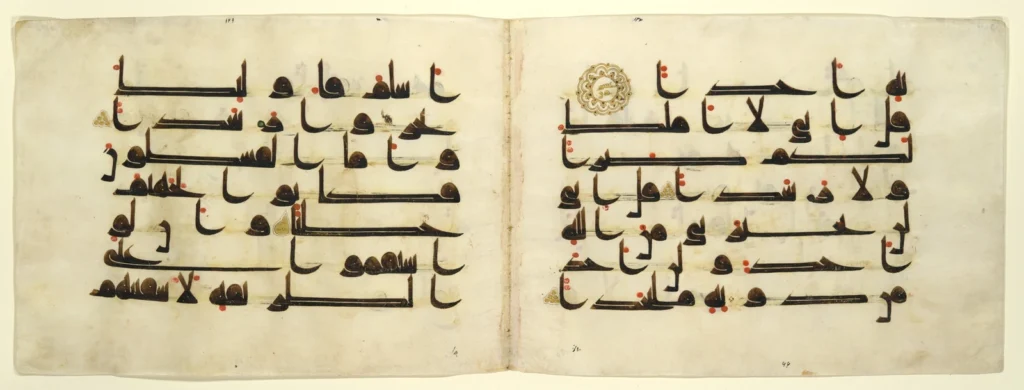
Bifolium from an early Qur'an manuscript in kufic script, showing red and green vowel marking
Bifolium from a Qur’an manuscript, kufic script with vowel marking in red and green. The Metropolitan Museum of Art, Open Access.

Duration

Four semesters — one year

Structure

12 weeks per semester · 2 classes per week · 24 lectures

Languages

English and Urdu

Level

Diploma — beginners welcome

Semester overview

Parts of speech, the nominal sentence, pronouns, iḍāfah, the verb, and the governing particles — twenty-four lectures across four units.

Unit one covers the parts of speech and their identifying markers, the nominal sentence, definiteness and pronouns. Unit two covers demonstratives, relatives, iḍāfah, adjectives and prepositions. Unit three covers the past and imperfect verb, subject and object, the imperative and the passive. Unit four covers kāna and inna with their sisters, the particles of naṣb and jazm, and the numerals.

Detailed treatment of the marfūʿāt, manṣūbāt and majrūrāt; mafʿūl bihi, mafʿūl muṭlaq, mafʿūl lahu, ḥāl, tamyīz and istithnāʾ.

In morphology: the patterns of the bare and augmented triliteral verb, active and passive participles, verbal nouns, and the foundations of iʿlāl and ibdāl. A brief introduction to balāghah is given towards the end of the semester so that Semester Three does not begin unfamiliar.

ʿIlm al-maʿānī: statement and performative, taqdīm wa-taʾkhīr, ḥadhf, qaṣr, faṣl wa-waṣl. ʿIlm al-bayān: simile, metaphor, metonymy and figurative usage. ʿIlm al-badīʿ: paronomasia, antithesis and assonance.

Qur’anic styles are treated in their own right: iltifāt, repetition, verse-endings, and the balance between concision and amplification.

Four-dimensional analysis of any verse: grammatical parsing, morphological breakdown, lexical investigation using the Mufradāt and the literature of gharīb and wujūh wa-naẓāʾir, and rhetorical observation.

Students work directly with the iʿrāb al-Qur’ān literature, comparing their own analysis against al-Tibyān and al-Darwīsh. The semester is largely continuous practice and presentation.

What distinguishes this programme

  • The Qur’an treated as a corpus. Rules are illustrated from the whole text rather than from one chapter, so structures are seen in variety.
  • Every class in three segments. Rule, then Qur’anic examples, then practical application. The third is never omitted.
  • Vocabulary taught by measured frequency. The word list is derived from a count of the entire Qur’anic text, not from an inherited claim. The target is 1,000 high-frequency stems, which account for approximately 77% of Qur’anic word occurrences.
  • Every citation verified. All Qur’anic examples in the curriculum were checked programmatically against the complete text — wording, sūrah and verse number.

Teaching approach

Methodology. Each lecture presents one grammatical topic, three verified Qur’anic examples of it, and a practical exercise applying it. Ten to twelve high-frequency words are assigned per lecture and revised for two minutes at the start of the next. Grammatical charts and syntax trees are used consistently, with a fixed colour system maintained across the whole programme.

Philosophy. Receptive skill takes precedence. The purpose is to understand the Qur’an, not to speak Arabic, and so comprehension, structural recognition and analysis are placed ahead of conversation and composition. Translation is withdrawn gradually and deliberately across the year.

Who this programme is for

  • Students who wish to read the Qur’an without depending on translation
  • Teachers of Islamic studies requiring a working command of Qur’anic grammar
  • Ḥuffāẓ who recite the text but have not studied its language
  • Students preparing for advanced study in tafsīr or ḥadīth
  • Beginners, including those who have never studied Arabic grammar

Learning outcomes

  • Distinguish noun, verb and particle by their identifying markers
  • Identify the constituents of nominal and verbal sentences within any verse
  • Conjugate the past and imperfect verb and identify the form used
  • Recognise the effect of the governing particles and state the resulting cases
  • Produce a complete grammatical parsing of a verse unaided
  • Command 1,000 high-frequency Qur’anic stems

Primary references

The Noble Qur’an — the primary source; all examples drawn directly from it

Al-Ājurrūmiyyah — Ibn Ājurrūm

Qaṭr al-Nadā and Mughnī al-Labīb — Ibn Hishām

Shadhā al-ʿArf fī Fann al-Ṣarf — al-Ḥamlāwī

Al-Balāghah al-Wāḍiḥah — al-Jārim and Amīn

Mufradāt Alfāẓ al-Qur’ān — al-Rāghib al-Aṣfahānī

Iʿrāb al-Qur’ān al-Karīm wa-Bayānuh — al-Darwīsh

Al-Tibyān fī Iʿrāb al-Qur’ān — al-ʿUkbarī

Durūs al-Lughah al-ʿArabiyyah — Dr V. Abdur Rahim

Responsible use of AI

Artificial intelligence produces the grammatical charts, syntax trees, morphological diagrams and mind maps that this programme uses heavily.

A stated limit: no grammatical ruling and no lexical meaning is accepted from AI. Every meaning is established from al-Mufradāt or the Muʿjam; every parsing from al-Darwīsh or al-Tibyān. Students are told this on the first day, and it is the principle that protects the academic standing of the programme.

FAQ

Yes. The programme begins with the three categories of word and assumes nothing prior.

No. This programme teaches you to read and analyse the language of the Qur’an. It does not teach you to speak contemporary Arabic.

No, and it would be dishonest to suggest otherwise. After Semester One you should be able to look at a verse and identify its structure — noun, verb, subject, genitive construction. That capacity is what makes the remaining three semesters possible.

Some memorisation is unavoidable, but the method is to use each rule immediately rather than to memorise it in advance. Every class ends with application.

Ten to twelve words per lecture, revised briefly at the start of the next. Approximately 250 words per semester.

Every citation was checked programmatically against the complete Qur’anic text — both the wording and the sūrah and verse number.

After this programme

  • Advanced Naḥw and Ṣarf — the classical grammatical literature
  • Tafsīr studies — reading the commentaries in Arabic
  • Diploma in Hadith Studies — applying the same competence to ḥadīth text

This academic programme has been officially announced as part of the Dr. Seema Tahir Institute’s educational vision.

The curriculum is currently in its final stage of academic development.

Student enrolment will open following the Institute’s official launch and the completion of all necessary legal and administrative requirements.

Detailed schedules, admission procedures and the academic calendar will be announced through the Institute’s official website.

Register your interest

Programme Interest

Coming soon

Course Outline

A detailed academic outline of this programme will be available to download following the official launch.
Available after launch.

Student Portal

Enrolled students will access course materials, schedules and assessments through the Institute’s student portal.
Opening with the first cohort.